AI Insights, Real Stories, and Game-Changing Guides for the Next-Gen Furnishing Professional.

Blog
How to Improve Quotation-to-Order Conversion for Furnishing Businesses
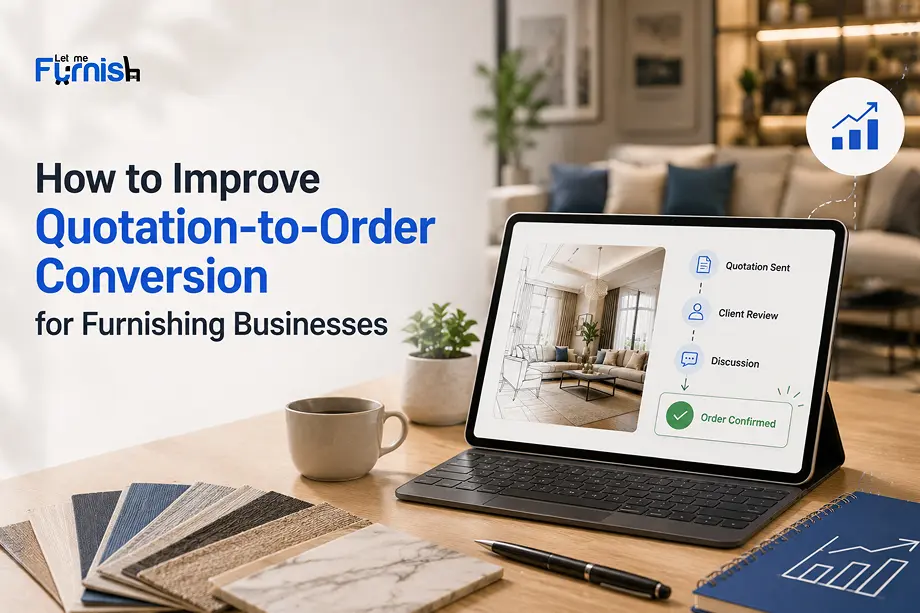
For a furnishing business, generating quotations is only the beginning of the sales process. The real challenge is converting those quotations into confirmed orders.
Quotation-to-order conversion measures how effectively a furnishing business turns submitted quotations into confirmed orders. Improving this conversion rate can increase revenue without requiring the business to generate more leads.
Furnishing quotations are often more complex than standard retail purchases. They may include multiple products, customizations, materials, labour, installation, delivery, taxes, and project-specific requirements. A small communication gap or delay can cause a customer to postpone the decision or choose another supplier.
The good news is that furnishing businesses can improve quotation conversion by creating a structured process around pricing, follow-ups, approvals, customer communication, and project readiness.
What Is Quotation-to-Order Conversion?
Quotation-to-order conversion is the percentage of quotations that eventually become confirmed customer orders.
Formula: Quotation-to-Order Conversion Rate = Confirmed Orders ÷ Total Qualified Quotations × 100
For example, if a furnishing company sends 100 qualified quotations and 25 become confirmed orders, its quotation-to-order conversion rate is 25%.
Why Do Furnishing Quotations Fail to Convert?
Common problems include slow quotation preparation, incorrect or unclear pricing, lack of follow-up, too many quotation revisions, poor presentation, unclear product specifications, hidden costs, long approval cycles, weak communication, and delayed responses to customer questions.
In many cases, the problem isn't the price alone. The customer may simply lack enough confidence or clarity to make a purchasing decision.
1. Respond to Furnishing Enquiries Quickly
Speed matters when a potential customer is actively comparing suppliers. A delayed quotation can result in lost customer interest, competitors reaching the customer first, repeated follow-up calls, and longer sales cycles.
Businesses should establish a standard internal response time for qualified enquiries. The goal should not simply be to send the fastest quotation, but to provide a fast, accurate, and complete quotation.
2. Understand the Customer Before Preparing the Quote
Before preparing a proposal, sales teams should understand the type of furnishing required, project size, preferred materials, design preferences, expected timeline, budget expectations, installation requirements, delivery requirements, and customization needs.
Sending a generic quotation without understanding the customer's priorities can make the proposal appear less relevant.
3. Create Clear and Professional Quotations
A professional quotation can improve customer confidence. Organize project details, products or services, additional costs, and commercial terms into logical sections.
Include customer and project details, product descriptions, quantities, unit prices, delivery and installation charges, payment schedules, delivery timelines, warranty information, taxes, validity, and terms and conditions.
4. Avoid Pricing Errors
For furnishing businesses, quotations can involve dozens or even hundreds of line items. Manual calculations increase the possibility of incorrect quantities, wrong product prices, missing labour charges, incorrect discounts, tax calculation errors, and duplicate items.
Automated quotation tools can reduce these risks by standardizing calculations and pricing structures.
5. Offer Multiple Options Instead of One Price
Customers don't always have a fixed budget. Consider offering structured Standard, Premium, and Custom options. This gives customers flexibility while helping sales teams understand which factors influence the purchase decision.
6. Make the Value Proposition Clear
Customers don't always choose the cheapest quotation. They may consider material quality, design quality, durability, installation support, delivery timelines, warranty, customization, and after-sales service.
A quotation should explain why the proposed price represents value rather than simply listing prices.
7. Follow Up at the Right Time
One of the biggest reasons quotations remain unconverted is inconsistent follow-up. A structured process can include confirming receipt, answering questions, discussing feedback, handling revisions, and following up on the expected purchasing timeline.
8. Track Every Quotation Status
Every quotation should have a clearly defined status such as Draft, Sent, Viewed, Follow-up Required, Revision Requested, Negotiation, Approved, Order Confirmed, Lost, or On Hold.
This allows business owners to understand exactly where potential revenue is getting stuck.
9. Reduce the Time Between Quotation and Revision
Customers frequently request changes to materials, quantities, designs, specifications, or product selections. A centralized system makes revisions easier by keeping quotation information organized and allowing teams to update existing proposals instead of recreating them.
10. Use Customer Feedback to Understand Lost Quotations
When a customer does not proceed, businesses should try to understand why. Common reasons include price, postponed projects, competitor offers, changed requirements, unsuitable delivery timelines, or lack of purchase readiness. Tracking these reasons helps identify recurring problems and improve the sales process.
11. Connect Quotations With Project Execution
A quotation should not exist as an isolated sales document. Once a customer approves a quotation, important information should be available to procurement, production, inventory, installation, billing, and project management teams.
The LetMeFurnish case study about a furniture supplier scaling with project management software is particularly relevant here: it describes standardized quotes flowing into project timelines after approval, with design, procurement, and installation teams working from the same system.
12. Keep Customers Informed After Approval
After approval, customers want to know what happens next, when materials will be ordered, when production begins, when installation will happen, and when payments are due.
A clear transition from quotation to order increases confidence and reduces unnecessary communication.
13. Use Data to Improve Conversion Rates
Important metrics include quotation-to-order conversion rate, average quotation value, average sales cycle, revision rate, lost quotation rate, and lost reason. Monitoring these metrics reveals opportunities for improvement.
14. Identify Where Customers Drop Off
Suppose a furnishing business has 100 enquiries, 70 qualified leads, 50 quotations, and 20 orders. The business may not have a lead-generation problem; it may have a quotation-conversion problem.
Investigate whether quotations are sent too slowly, follow-ups are inconsistent, pricing is uncompetitive, proposals are unclear, revisions take too long, or sales teams are slow to respond.
15. Standardize the Quotation Process
A standardized workflow can be: Enquiry → Requirement Analysis → Site Visit → Cost Calculation → Quotation → Follow-Up → Revision → Approval → Order. Each stage should have a clear owner and expected completion time.
How Software Can Improve Quotation-to-Order Conversion
Technology can support customer information, quotation creation, pricing, revisions, follow-ups, quotation status, approvals, and conversion of approved quotations into orders.
For businesses replacing spreadsheets and scattered communication, the article on the future of furnishing businesses—from manual processes to full automation—provides useful context on centralized dashboards, digital material tracking, automated tasks, and faster approval workflows.
The LetMeFurnish article on common challenges in furnishing project management also explains how manual management can make it difficult to track orders, inventory, and payments, while centralized tools can support quote generation and broader store operations.
Businesses evaluating alternatives can also review the LetMeFurnish guide to an alternative to Furnishkaro software, which discusses project management, inventory and supplier management, integrations, customer experience, and reporting.
Common Mistakes That Reduce Quotation Conversion
Sending generic quotes, competing only on price, ignoring follow-ups, taking too long to make revisions, not tracking lost quotations, and separating sales from operations can all reduce conversion.
Frequently Asked Questions
What is a good quotation-to-order conversion rate for a furnishing business?
There is no universal benchmark because conversion varies by project type, customer quality, pricing, geography, product category, and sales cycle. Establish your own baseline and improve it consistently.
How can furnishing businesses increase quotation conversions?
Respond quickly, understand customer requirements, create clear quotations, follow up consistently, simplify revisions, communicate value, and track why quotations are won or lost.
Does a lower quotation price guarantee more orders?
No. Customers also consider material quality, service, delivery time, installation, warranty, design, and overall value.
How important is follow-up after sending a quotation?
Follow-up is critical because customers may need clarification, revisions, additional options, or time to decide.
Can software help improve quotation-to-order conversion?
Yes. Software can speed quotation creation, organize customer information, track quotation status, manage revisions, and connect approved quotations with project operations.
Conclusion
Improving quotation-to-order conversion isn't simply about offering lower prices. It requires a complete sales process that makes it easy for customers to understand the proposal, ask questions, request changes, approve the quotation, and move confidently toward an order.
Furnishing businesses should focus on quotation accuracy, response speed, professional presentation, structured follow-up, and seamless conversion from quotation to project execution.
A centralized furnishing management platform can connect sales activities with quotations, orders, inventory, payments, and project workflows. LetMeFurnish provides a furnishing-focused platform designed to bring these operations together.